
01
Audit Overview
Your store's untapped revenue potential — and how to unlock it
Why We Created This Audit
We analyzed https://www.amandean.com the same way we've audited 350+ e-commerce stores — looking for the specific gaps between your current experience and what top-performing Health & Wellness stores deliver. Every finding in this report is a revenue opportunity backed by industry data and competitive benchmarks.
Critical
Important
Opportunities
What We Analyzed
- UX & Conversion Design findings
- Performance & Speedvs 3 competitors
- Technology & App StackPlatform + 11 apps
- Industry BenchmarksHealth & Wellness
Pages Analyzed
- Homepage findings
- Collection Pages findings
- Product Pages (PDP) findings
- Cart & Checkout findings
 This audit was prepared by Growisto — a CRO-led Website development team behind 167% conversion growth for Atomberg, 46% CR lift for TyresNmore, and 350+ e-commerce projects.
03
UX & Conversion Findings
Page-by-page analysis with visual comparisons against top Health & Wellness stores
Concern-Based Navigation Missing — Shoppers Must Browse All Products to Find What They Need
Observations
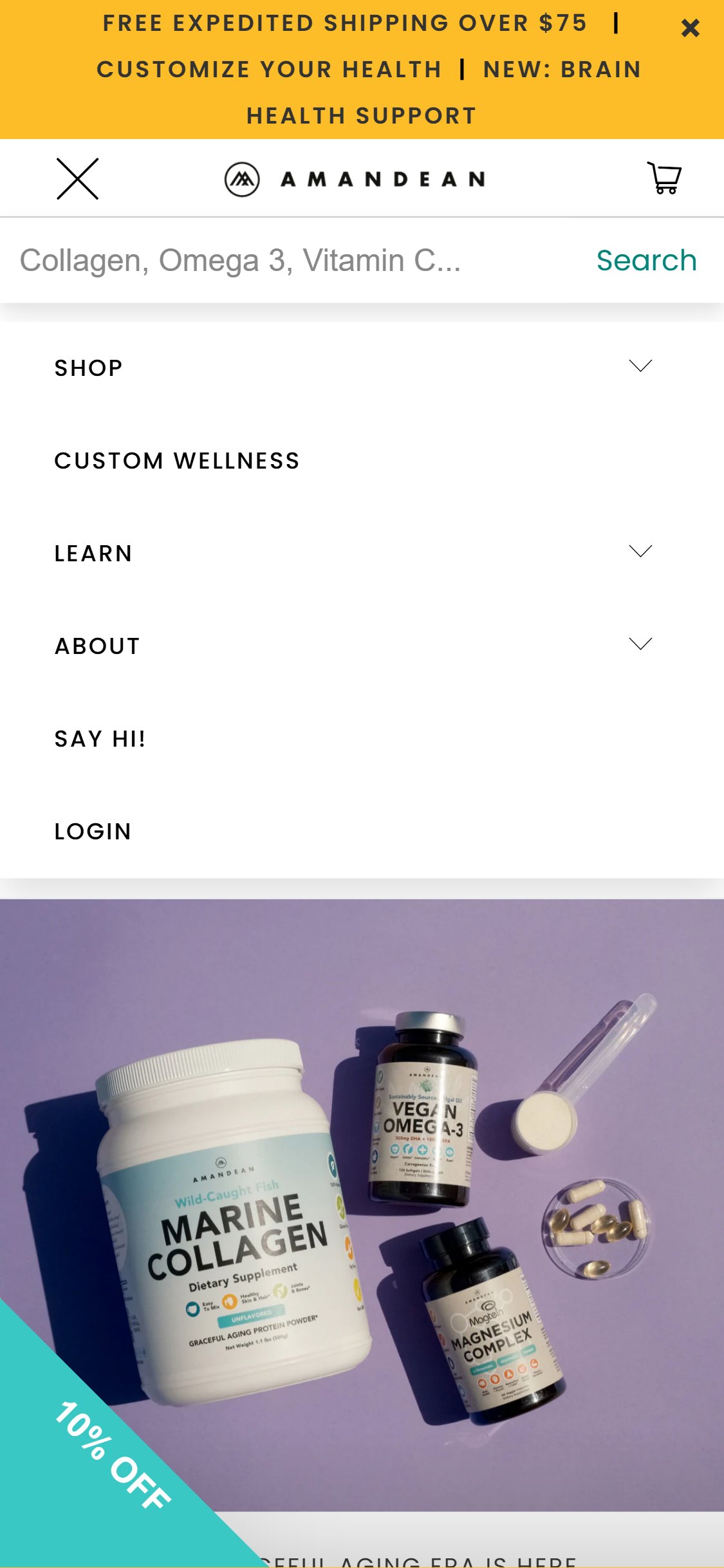
- The mobile hamburger menu shows: SHOP, CUSTOM WELLNESS, LEARN, ABOUT, SAY HI!, LOGIN — 'SHOP' leads to a product grid with no category organization by health concern
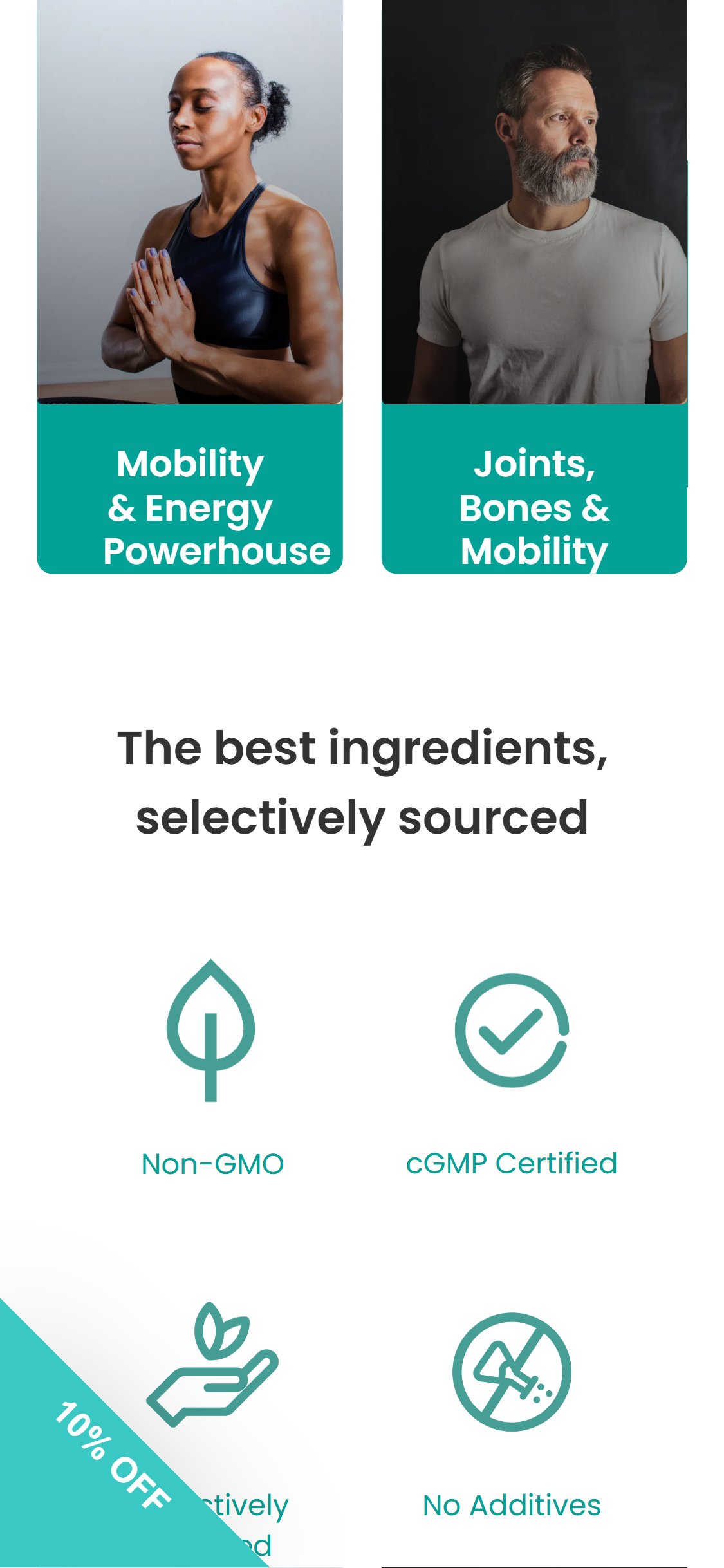
- Homepage body has concern tiles (Mobility & Energy, Joints Bones & Mobility, Skin Hair & Nails, Immune Health) as images, but these are not in the primary navigation — they're buried after scrolling past the hero
- A new visitor looking for 'brain health' or 'joint support' must either use search or browse all 15 products — no navigational shortcut by concern exists
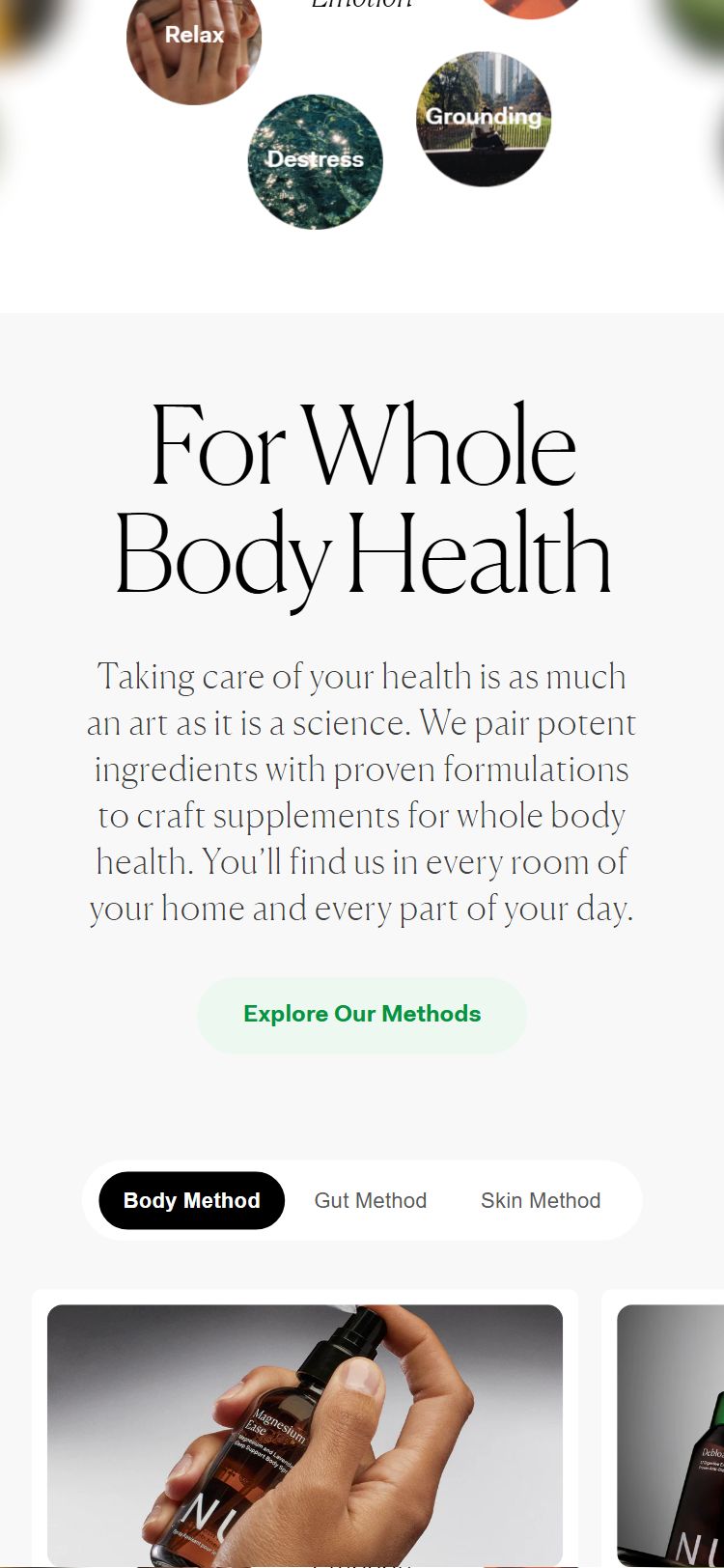
- 70% of US H&W stores (Onnit, Moon Juice, Seed) surface concern categories as top-level nav items: 'Cognition & Focus', 'Sleep & Recovery', 'Gut Health'
Recommendations
- Replace the generic 'SHOP' nav item with concern-based sub-categories: 'Skin, Hair & Nails', 'Joints & Bones', 'Immune Health', 'Cognition & Brain', 'Energy & Mobility' — each linking to a filtered collection
- Add a 'Shop by Concern' section in the hamburger menu as a horizontal icon-grid (the homepage tiles already exist — port them into the nav)
- Consider 'CUSTOMIZE YOUR HEALTH' (already in announcement bar) as a primary nav link — the quiz is a strong personalization entry point that should be easier to discover
No Clinical Study References or Evidence-Based Claims on Homepage
Observations
- Homepage quality claims are unsubstantiated marketing copy: 'Science backed, Mother Nature approved', 'The best ingredients, selectively sourced' — no clinical references, no study citations, no specific efficacy numbers
- The homepage trust icons say 'Over 4,500 5 Star Reviews' and 'Selectively-Sourced Ingredients' but no quantified efficacy claims (e.g., '93% saw results', 'reduce cortisol by 24%', '4 Human Clinical Studies')
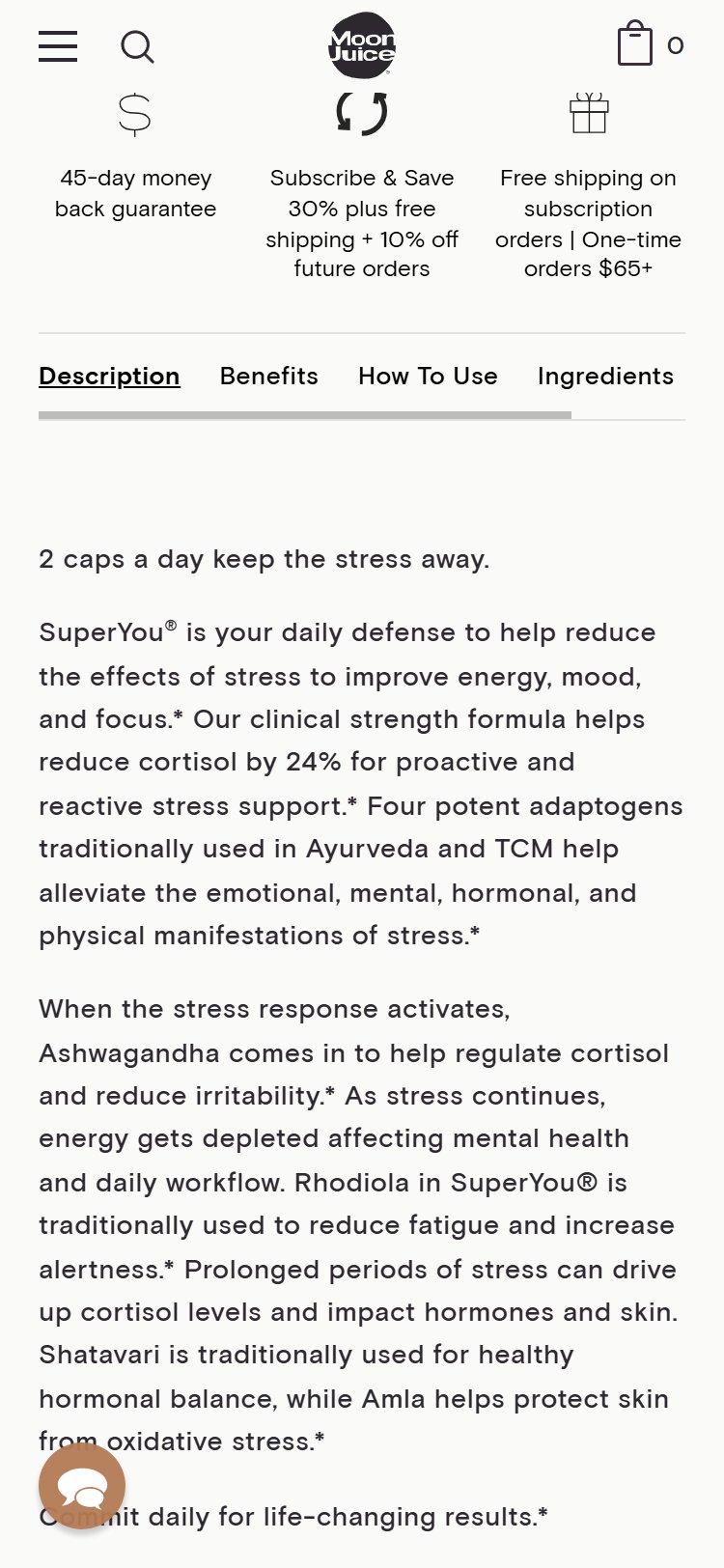
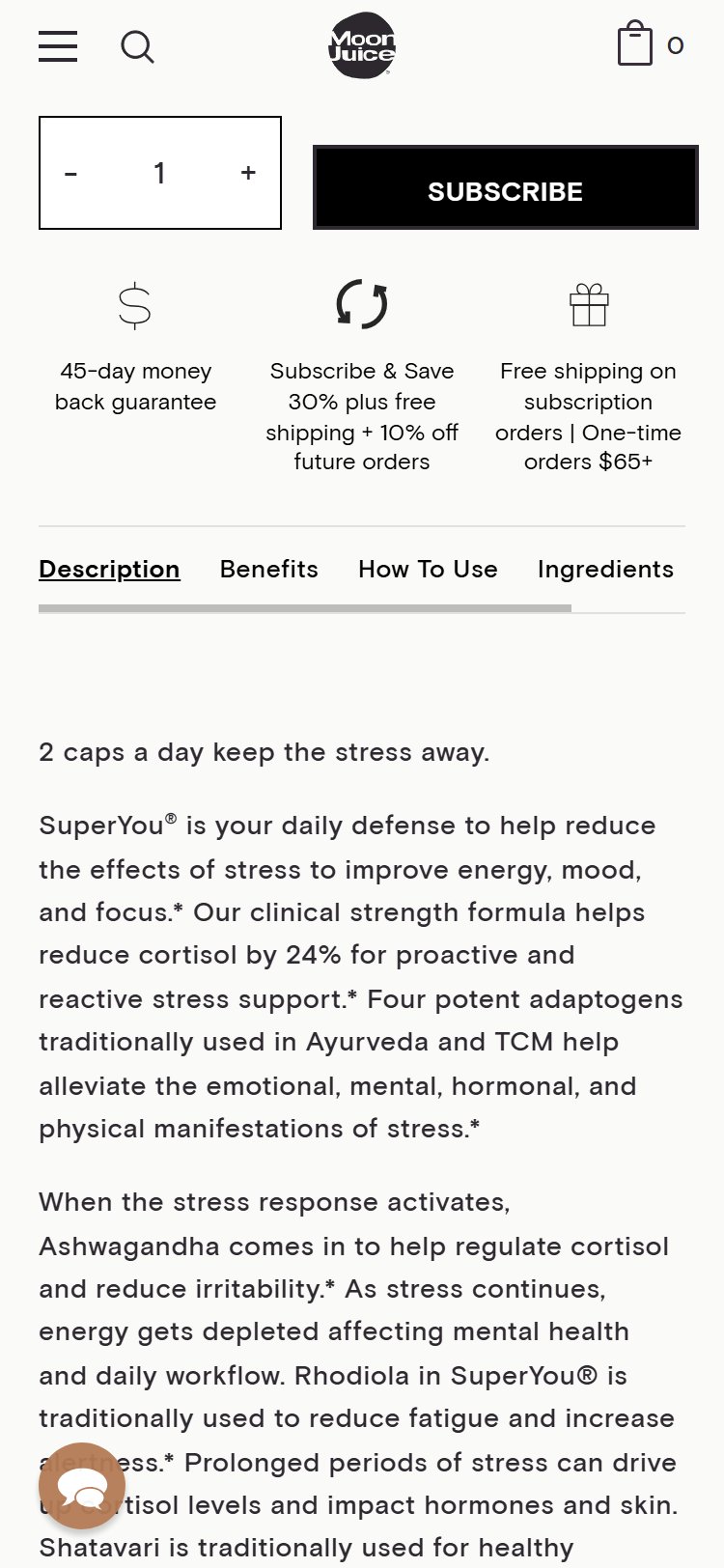
- 60% of US H&W stores cite clinical studies on the homepage (Ritual: '4 Human Clinical Studies', Seed: 'View Clinical Trials', Moon Juice: 'reduce cortisol by 24%*')
- US supplement shoppers are increasingly evidence-driven — clinical references directly convert skeptical first-time buyers in the $40–$50 price bracket
Recommendations
- Add a 'Backed by Science' section with 2–3 specific clinical stats per hero product: 'Hydrolyzed collagen shown to improve skin elasticity in 8 weeks*' with study footnotes
- Surface the 4,500+ review count more prominently as a social proof metric — currently shown as a small icon line, not as a hero trust statement
- Add a 'As Seen In' or press strip if Amandean has media coverage — the homepage currently has no third-party credibility signals beyond customer reviews
No Filter Bar on Collection Pages — Shoppers Cannot Narrow 15+ Products
Observations
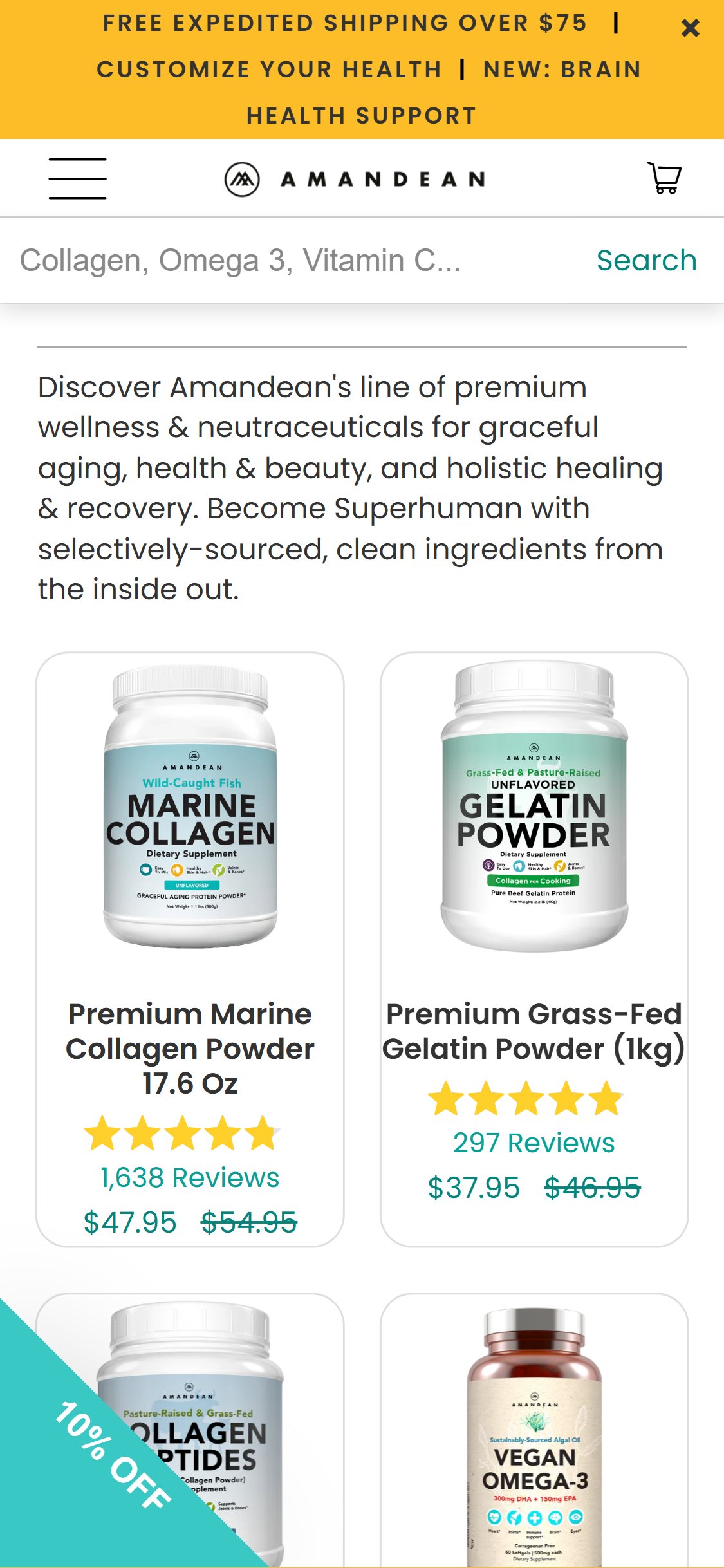
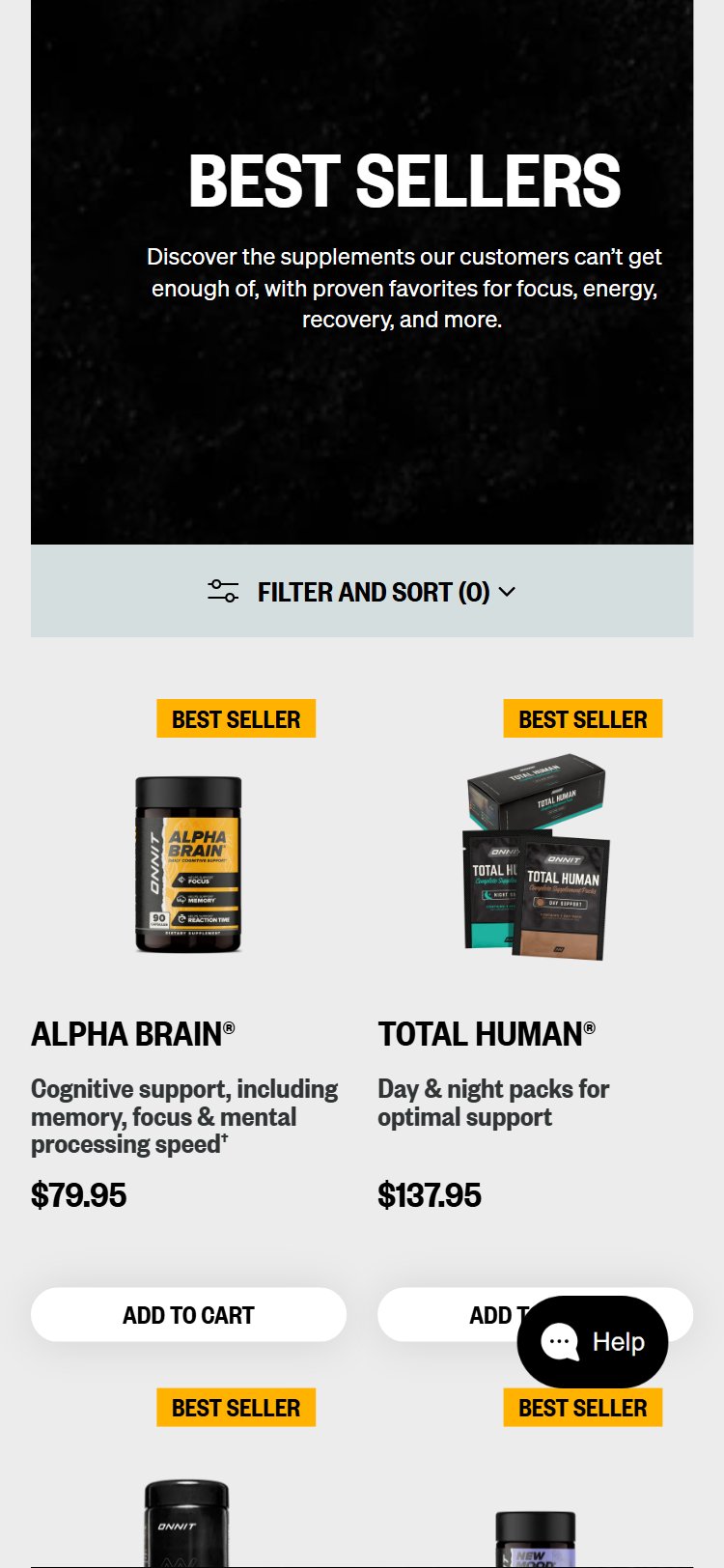
- The All Products collection page shows all 15 products in a grid with no filter UI, no sort dropdown, and no way to narrow by health concern, format (powder/capsule/liquid), price, or certification
- DOM inspection returned zero filter-related elements (no [class*='filter'], [class*='sort'], or related controls anywhere on the page)
- Users shopping for a specific need (e.g., 'joint support', 'vegan', 'under $40') must manually browse all cards with no discovery assistance
- 70% of US H&W stores provide concern-based filtering (e.g., Onnit: 'Cognition & Focus', 'Sleep Mood & Stress', 'Gut Health', 'Fitness') directly on collection pages
Recommendations
- Add a filter bar with at minimum: Health Concern (Skin & Hair, Joints & Bones, Immune, Cognition, Energy), Format (Powder, Capsules, Liquid, Packets), Price range slider
- Add a Sort dropdown: Best Sellers, Price Low-High, Most Reviewed, Newest — this alone significantly improves discovery for returning visitors
- Use Shopify's native filtering with collection metafields or a filter app (Boost Commerce, Searchanise) — Amandean's catalog is small enough that native filtering handles it well
No Subscription Pricing on Collection Cards — Shoppers See Higher Price at Discovery Stage
Observations
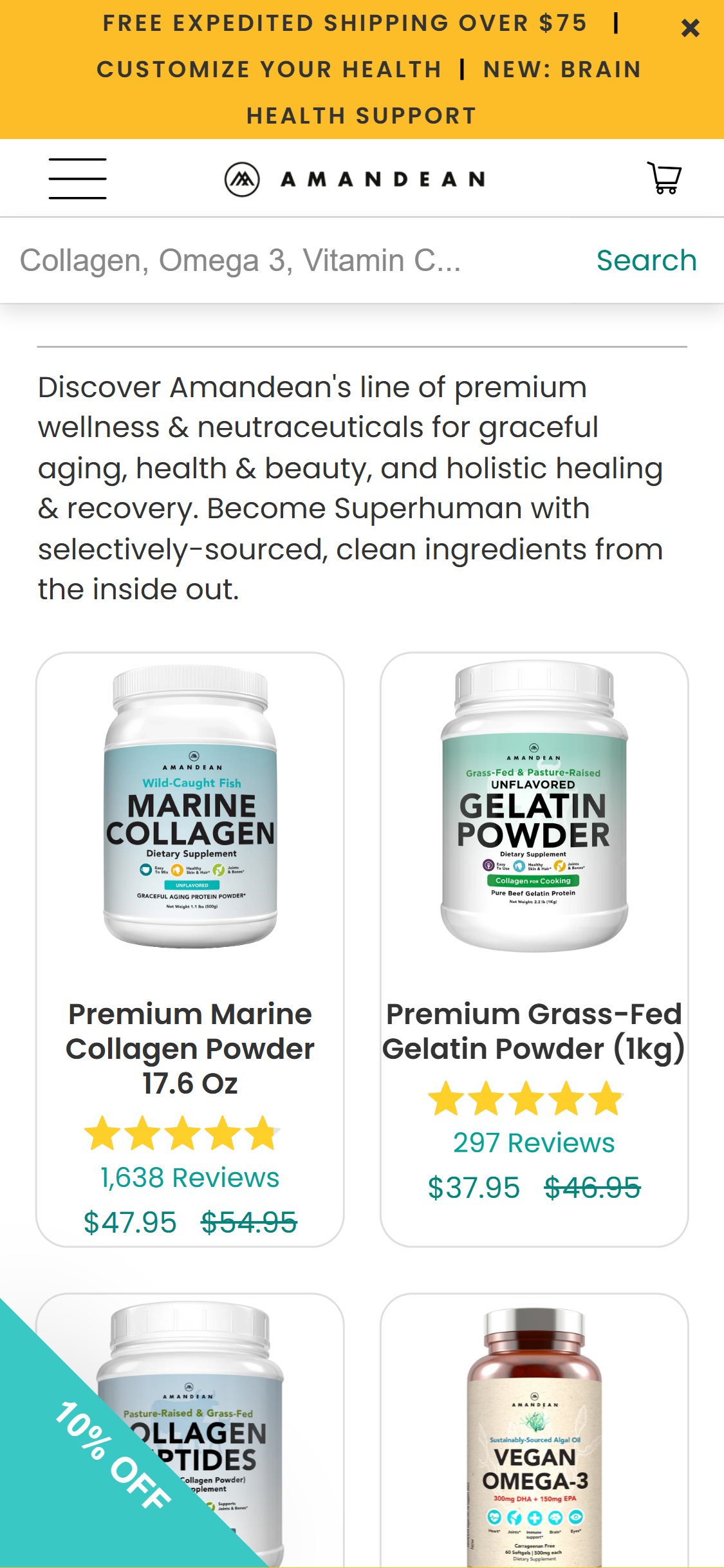
- Collection cards show only one-time purchase price (e.g., $47.95 ~~$54.95~~) — no subscription price is shown at the collection/discovery stage
- A shopper comparing Amandean's Marine Collagen at $47.95 against a competitor showing '$38/mo subscribe' perceives the competitor as better value before even clicking through
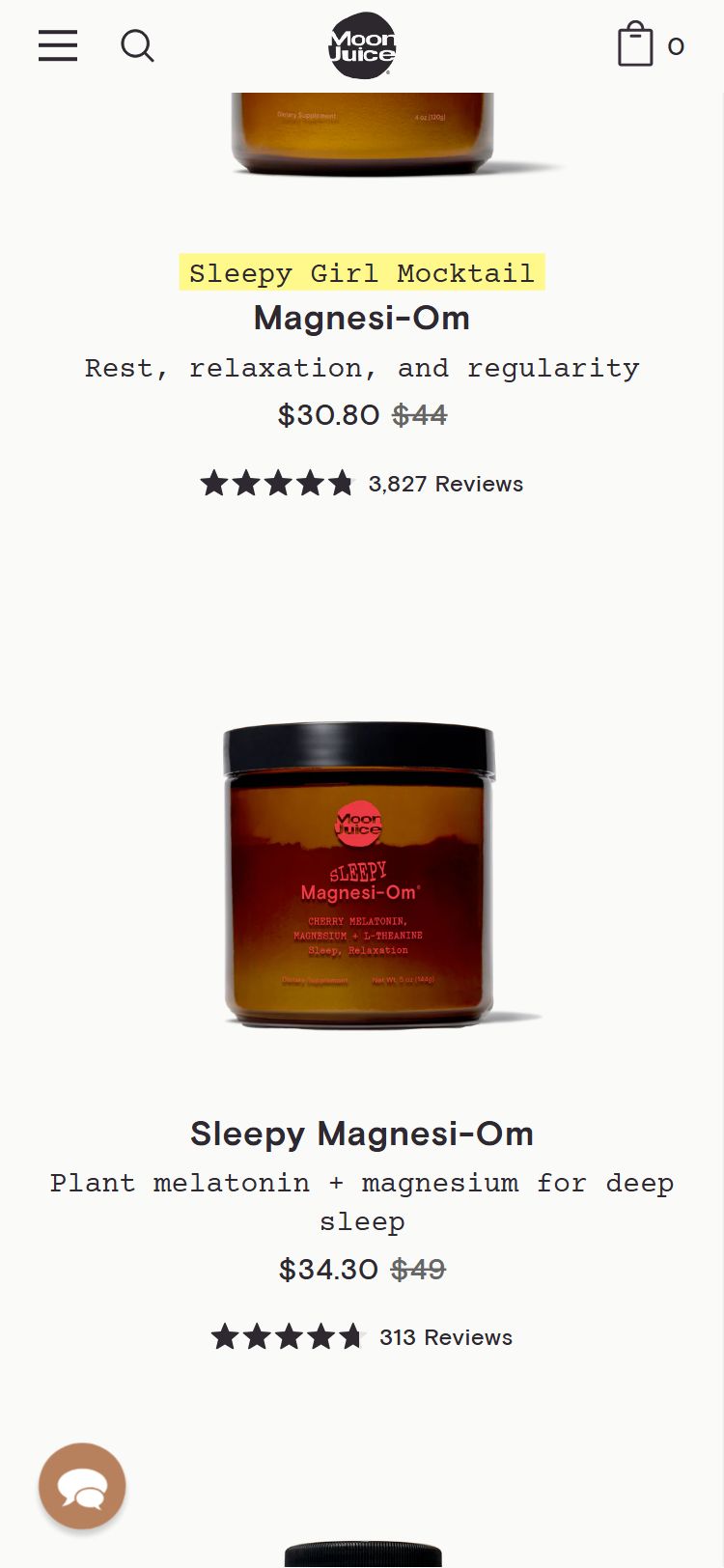
- 100% of US H&W stores (Moon Juice, Seed, Athletic Greens) display 'From $X.XX/mo' or 'Subscribe from $X.XX' on collection cards per benchmark data
- Recharge subscription infrastructure is already live — the collection card pricing update is a theme-level change, not a new app install
Recommendations
- Show subscription price on collection cards: 'From $43.16/mo with Subscribe & Save' as a secondary price line below the one-time price
- Add a small 'SUBSCRIBE & SAVE 10%' tag/pill on subscribable product cards to signal the option exists before the PDP click
- Alternatively, display the subscribe price as the primary price with 'or $47.95 one-time' as secondary — this is the approach all benchmarked US stores use
No Variant/Weight Indicators on Collection Cards — Shoppers Discover Sizes Only After Click-Through
Observations
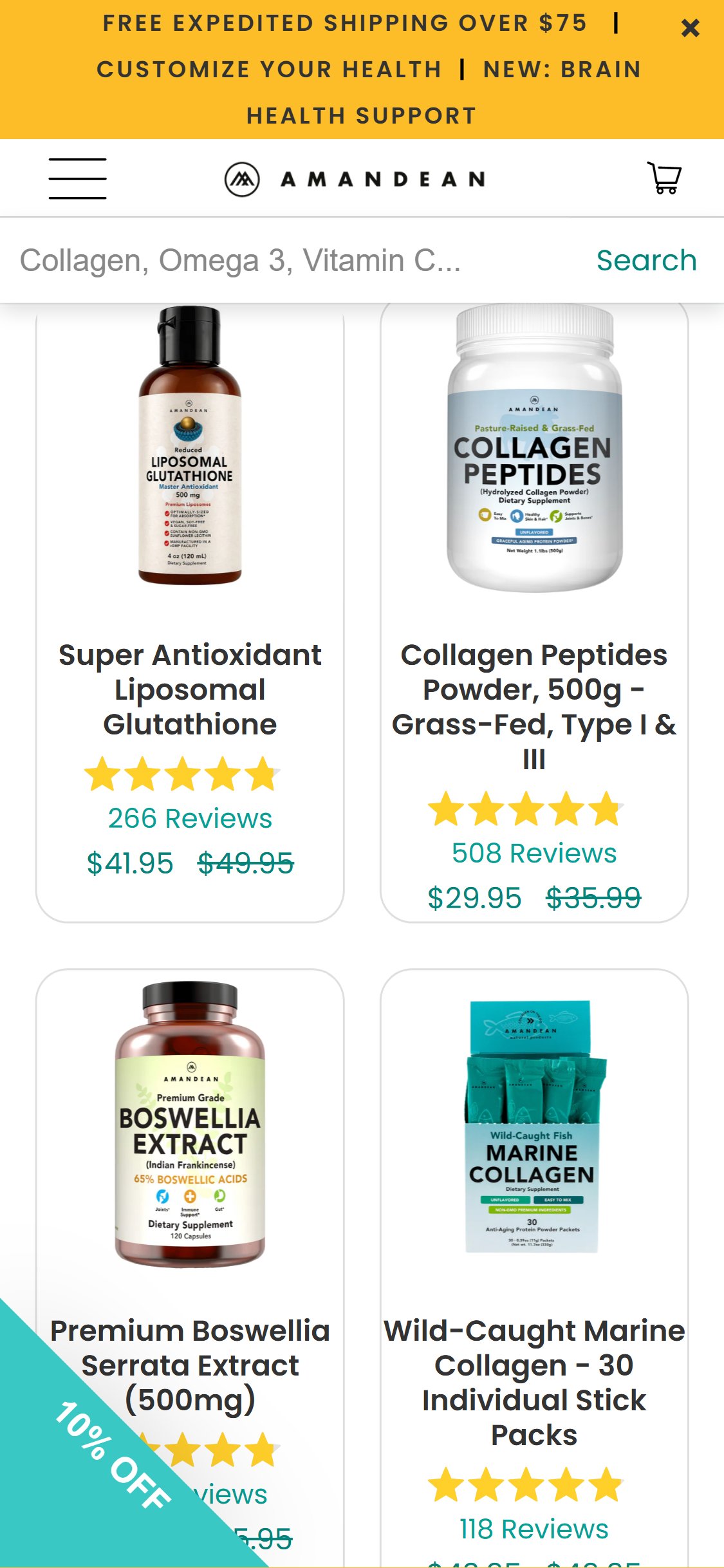
- Collection cards show product image, title, star ratings, and sale price — but no indication of available sizes, weights, or variants (e.g., '500g / 1kg' for Collagen Peptides, 'Softgels / Powder' for Omega-3)
- The Vegan Omega-3 card shows 'from $23.95' indicating multiple variants exist, but no size indicators or format swatches are visible
- Shoppers interested in a specific size must click into every PDP to discover options — increasing bounce rate from the collection page
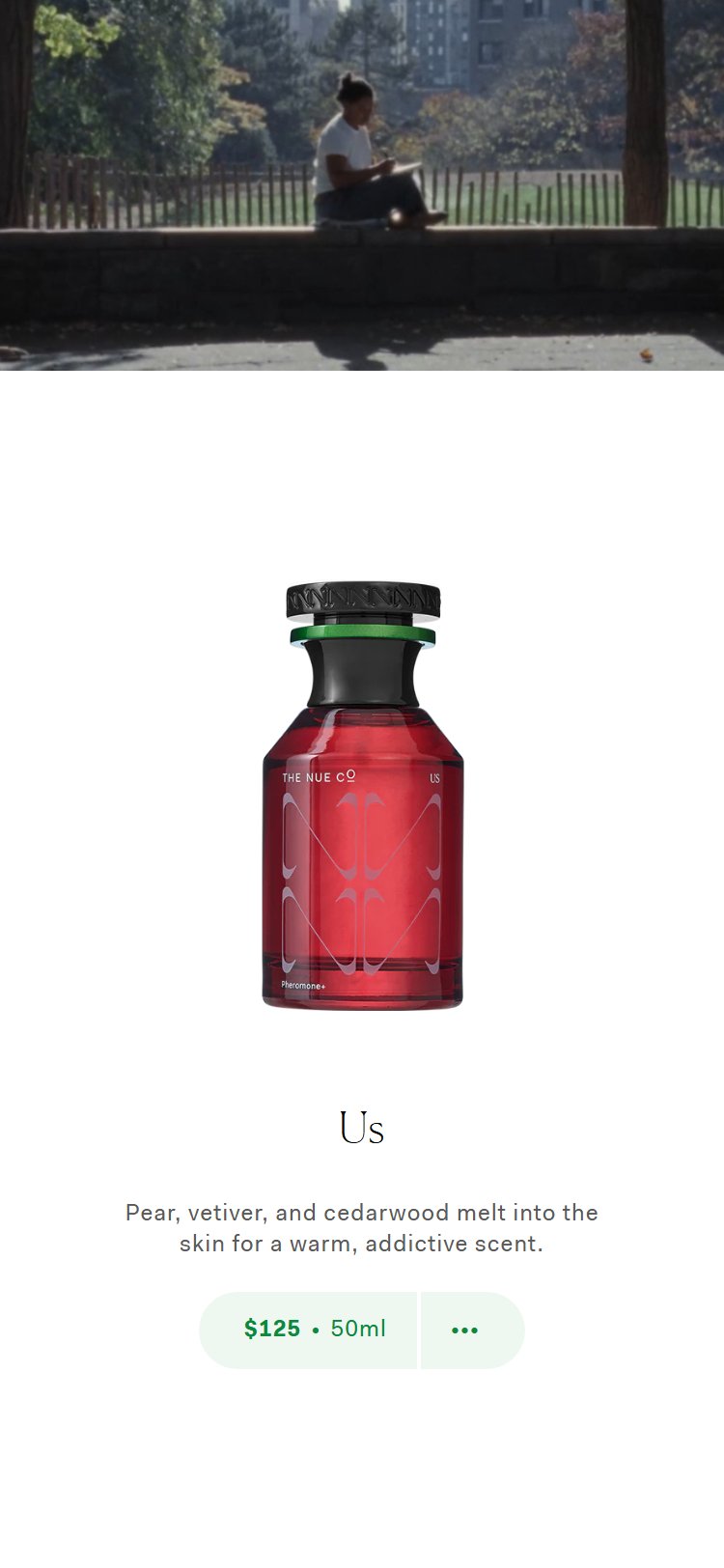
- Moon Juice and Onnit surface size/format options on collection cards: 'Mini / Standard / Value' size pills or 'From $X' with variant count
Recommendations
- Add size/weight pills below the price on collection cards for multi-variant products: '500g | 1kg' for powders, '60 caps | 90 caps' for capsules
- Use Shopify's native variant display on collection cards or a lightweight variant-on-hover app — this requires minimal theme development
- At minimum, show 'X sizes available' as a text indicator on multi-variant cards to signal discovery value without full swatch rendering
Sticky Add-to-Cart Bar Missing — Mobile Users Lose Purchase Access Mid-Scroll
Observations
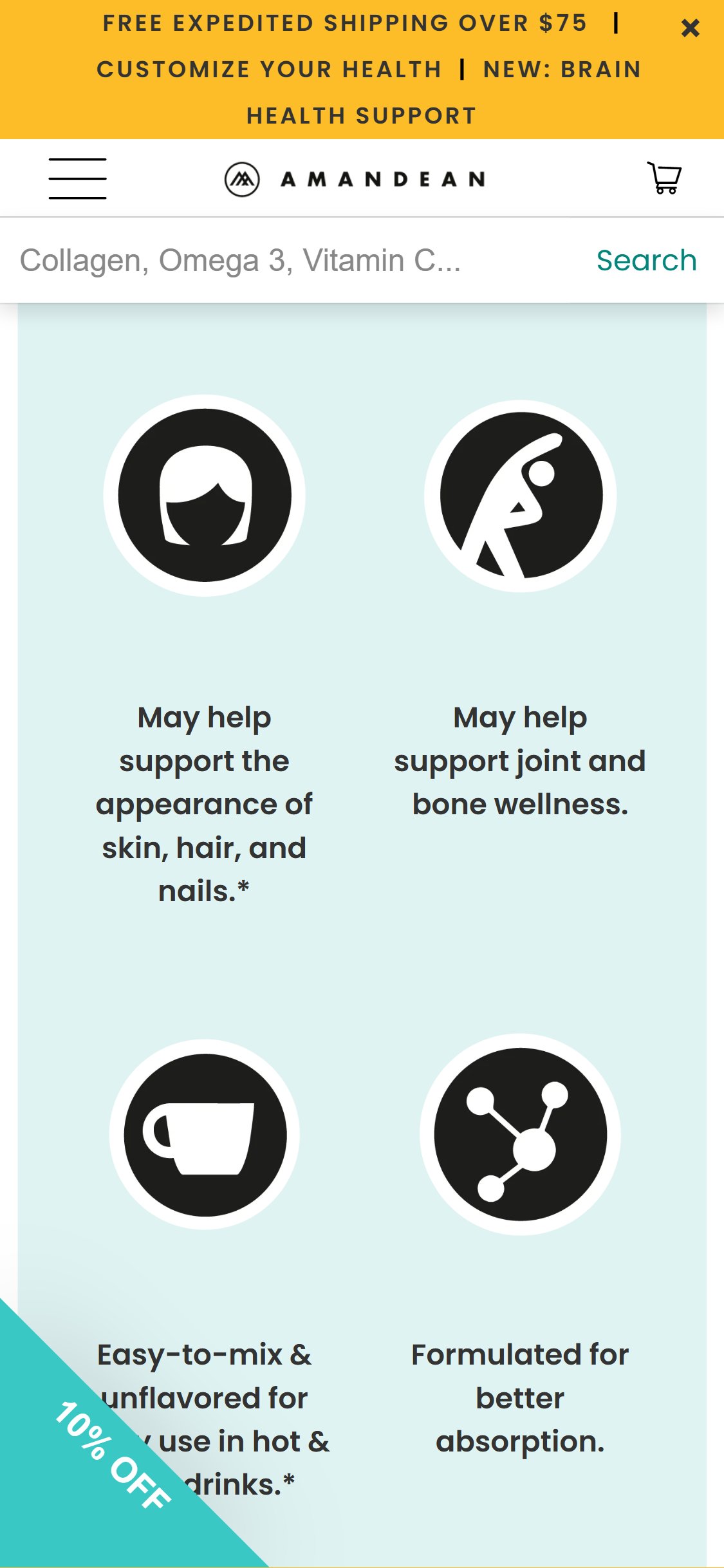
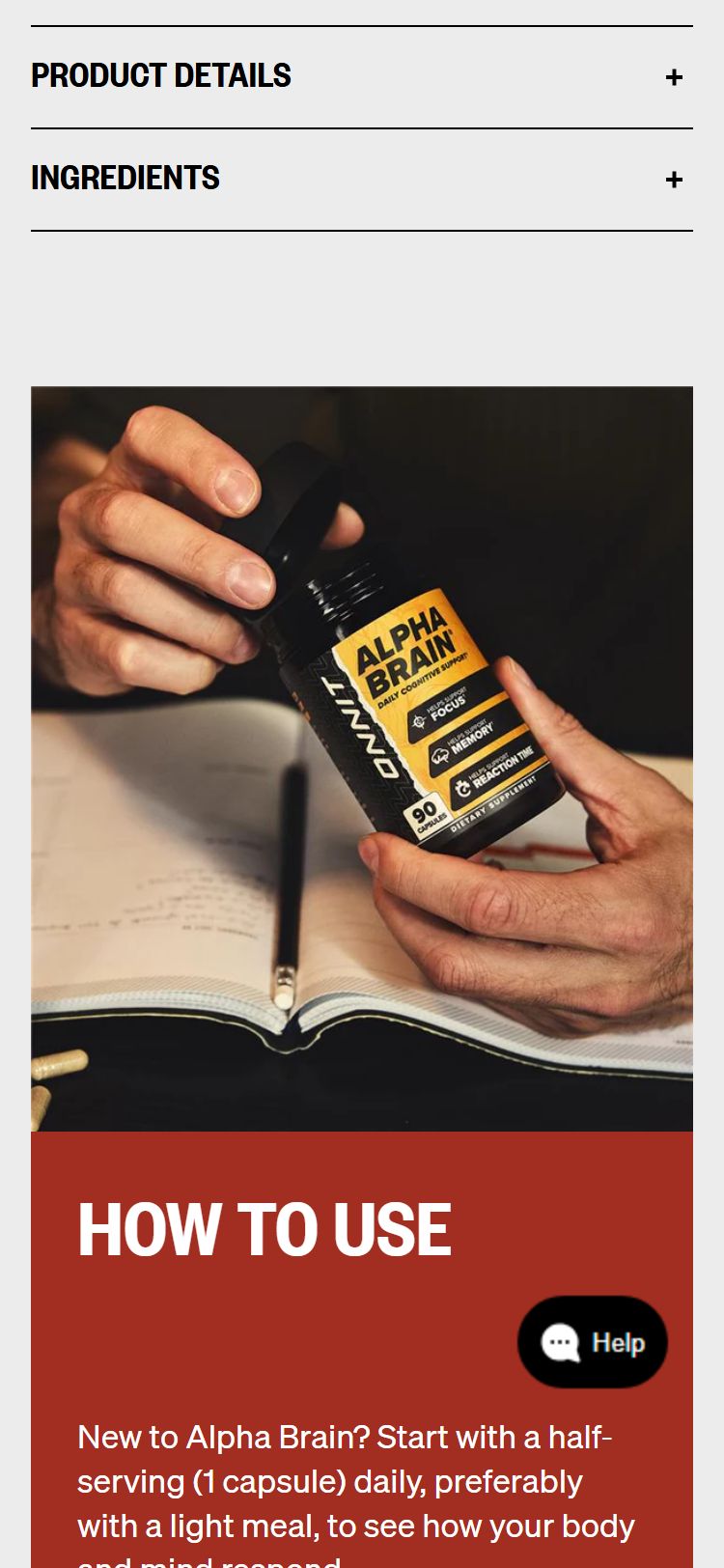
- On mobile (375px), scrolling past the inline ATC button leaves no fixed CTA at the bottom of the screen — the purchase action is completely inaccessible from any scroll position below the fold
- The PDP is content-heavy: image gallery, benefits icons, accordions, YouTube video, 'Frequently Bought Together' bundle — users scroll deeply but have no persistent way to purchase
- DOM inspection confirmed zero fixed/sticky ATC elements — only the site header is fixed
Recommendations
- Add a sticky bottom bar that appears when the inline ATC button scrolls out of view, containing product name, active price ($43.16 subscribe / $47.95 one-time), and a full-width 'Add to Cart' button
- Conditionally show/hide: sticky bar appears when ATC is above viewport, hides when ATC is visible — preventing duplicate CTAs
- Include the subscribe/one-time toggle in the sticky bar so users can switch purchase type without scrolling back up
No Certification Badges Near ATC — Trust Gap at the Moment of Purchase
Observations
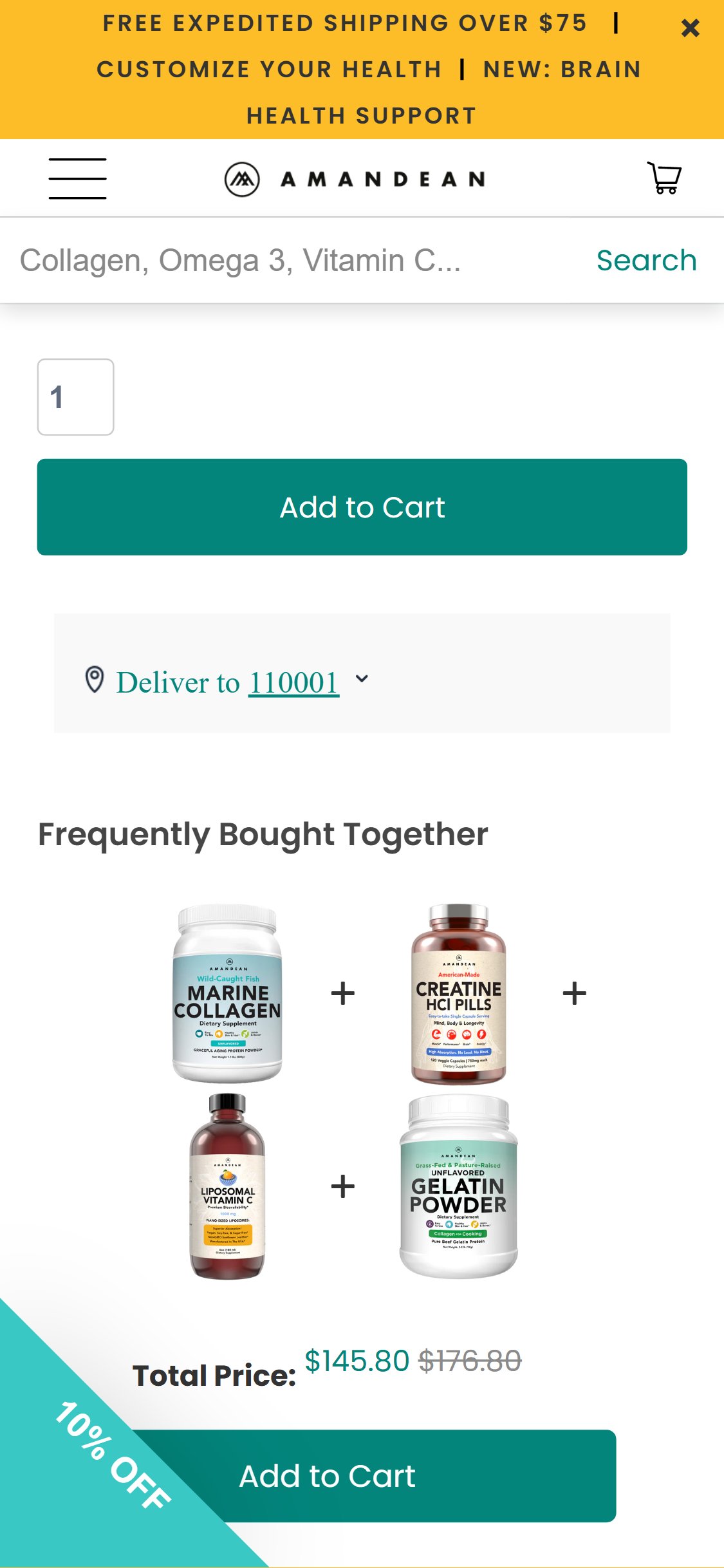
- The ATC zone (quantity selector → Add to Cart → Deliver to zipcode) contains zero trust or certification indicators — no Non-GMO badge, no cGMP badge, no 3rd-Party Lab Tested badge, no Plastic Neutral badge
- Amandean has legitimate certifications (cGMP, Non-GMO, 3rd-Party Tested) displayed only on the homepage icons section — never surfaced at the point of purchase
- Immediately below the ATC button is the 'Frequently Bought Together' bundle — trust reinforcement is completely absent from the purchase decision zone
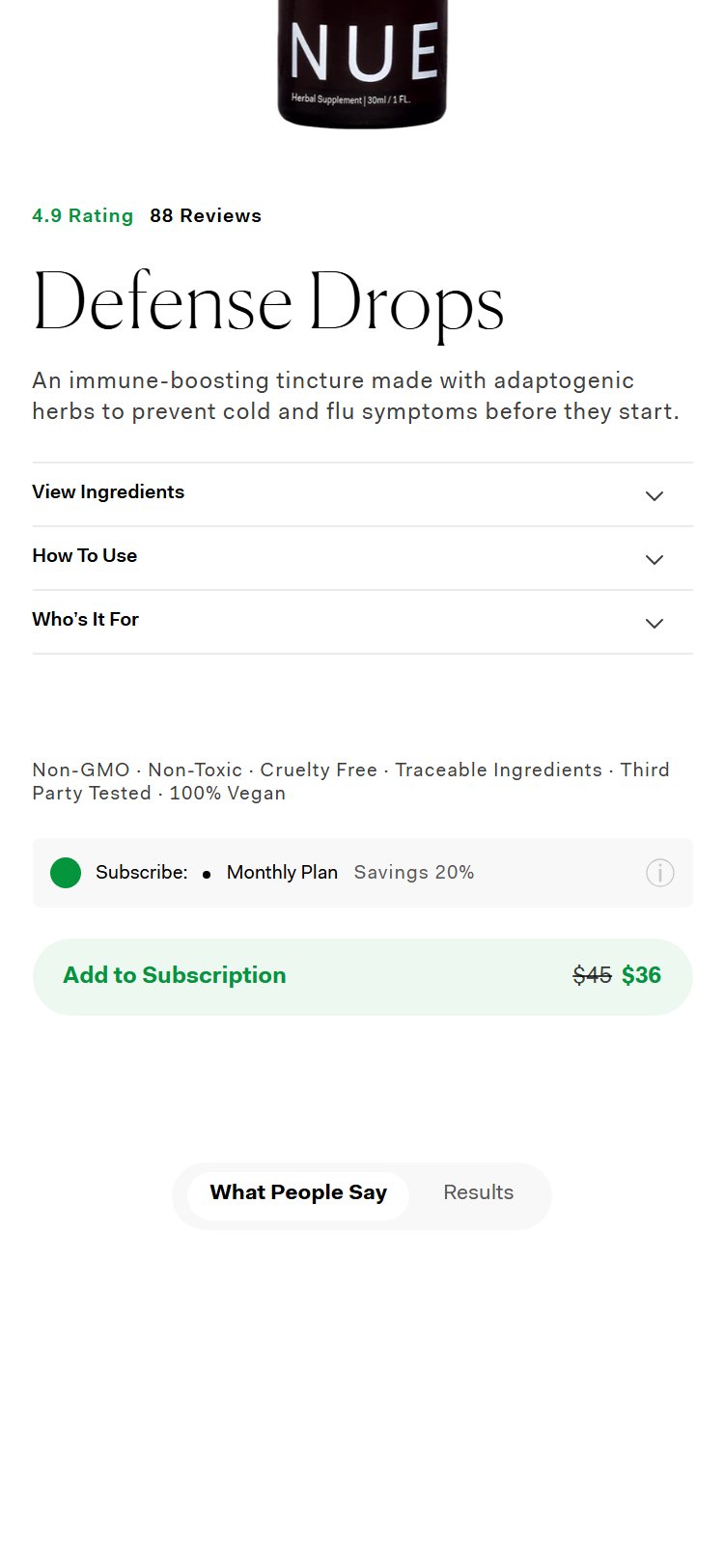
- 80% of US Health & Wellness stores display ≥4 certification badges near the ATC button (benchmark: Wellbeing Nutrition, Moon Juice, Onnit)
Recommendations
- Add a 4–6 badge strip between the 'Add to Cart' button and 'Deliver to' widget: Non-GMO | cGMP Certified | 3rd-Party Lab Tested | Plastic Neutral | Wild-Caught | No Additives
- Use icon + text format (not text-only) — iconographic badges are required for the standard to count per the benchmark
- Consider adding HSA/FSA eligible badge if applicable — 20% of US H&W stores now display this and it directly removes a price-sensitivity barrier
Subscription Defaulting to One-Time Purchase Loses 15–30% Recurring Revenue
Observations
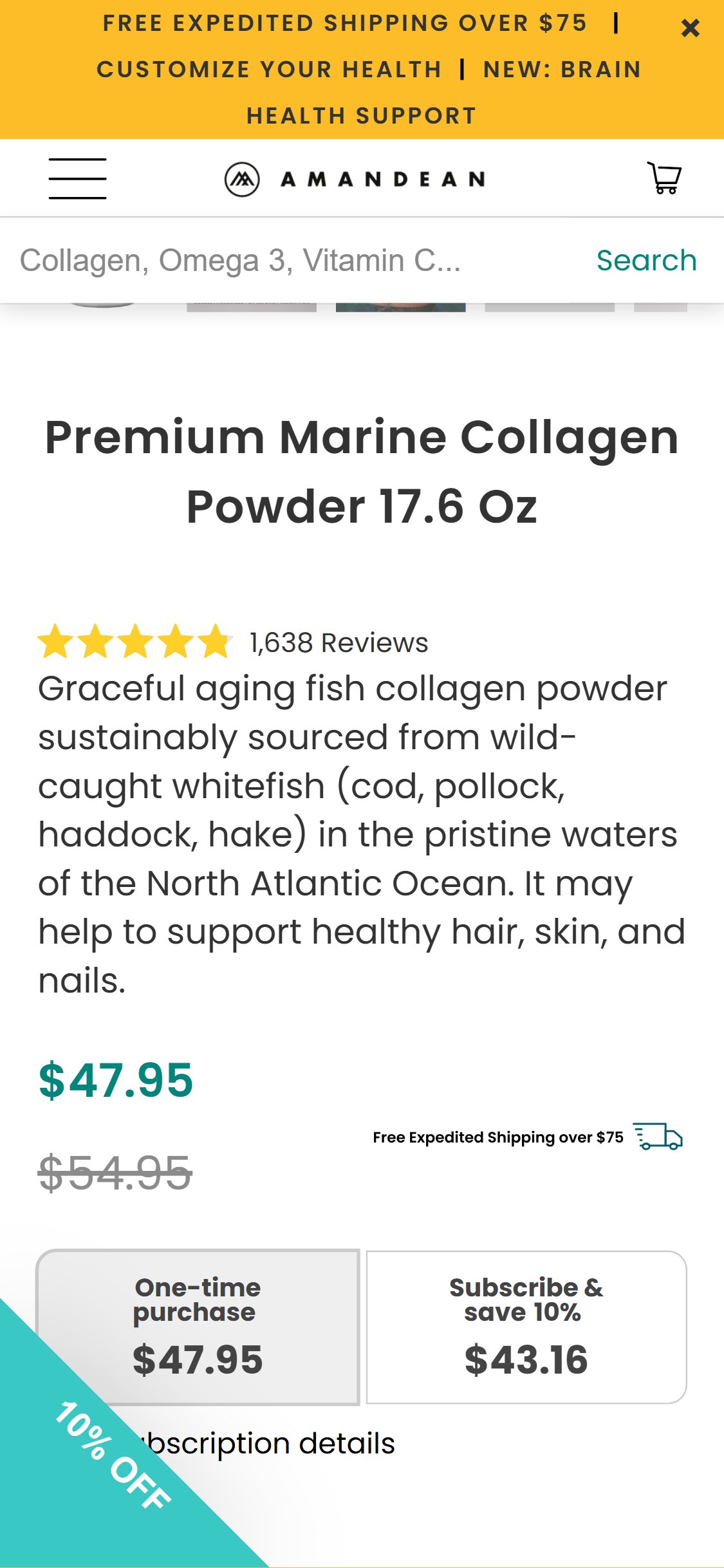
- The purchase selector on PDP shows 'One-time purchase $47.95' as the selected/highlighted option and 'Subscribe & Save 10% $43.16' as unselected — the higher-friction, lower-LTV option is the default
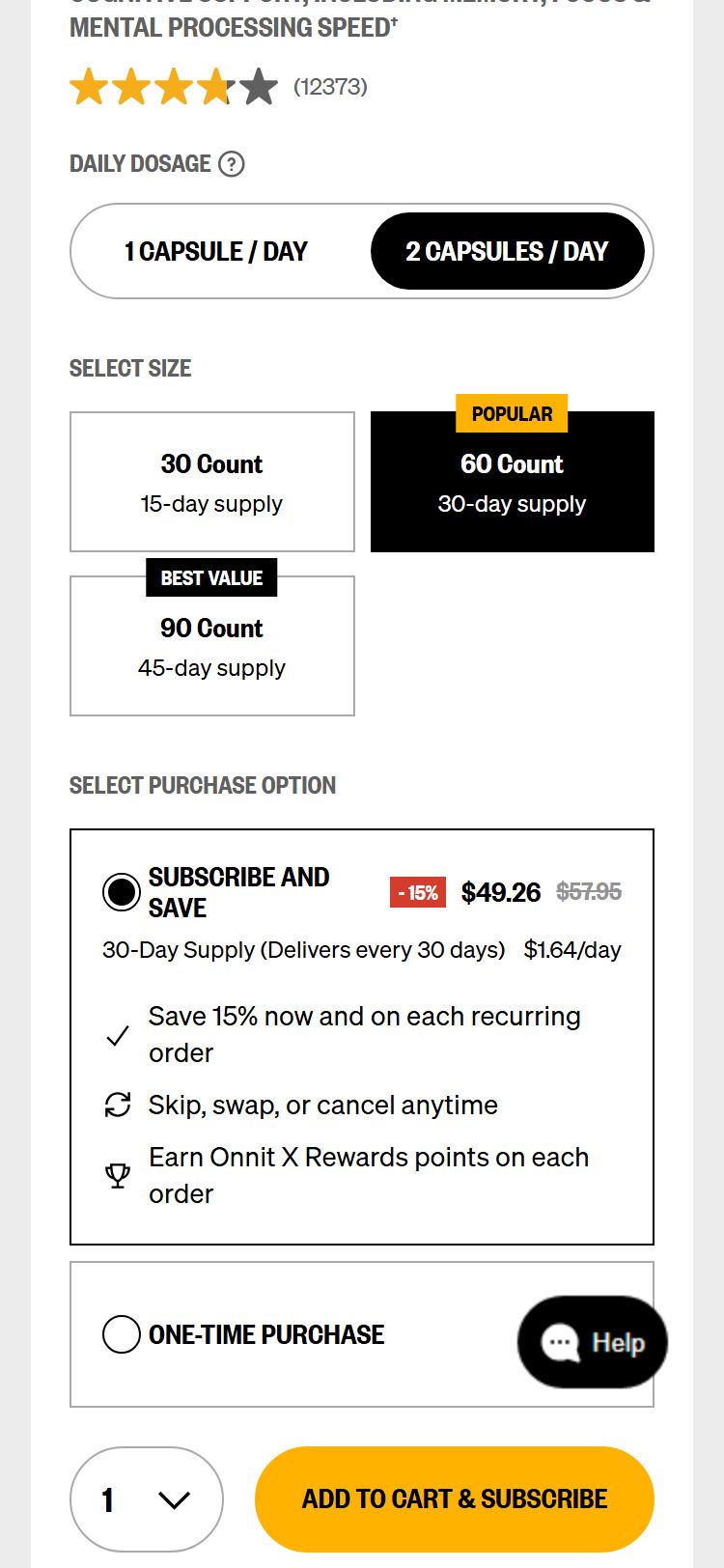
- 100% of US Health & Wellness stores audited pre-select the subscription option by default (Seed, Ritual, Athletic Greens, Onnit, Moon Juice)
- Subscription infrastructure (Recharge) is already installed and functional — this is a single configuration change with immediate LTV impact
- A user who adds to cart without noticing the subscription tab is locked into a one-time purchase — Amandean loses the auto-replenish revenue
Recommendations
- Switch the default selected state of the Recharge widget to 'Subscribe & Save 10%' — this is a single setting change in the Recharge dashboard
- Add social proof to the subscription option: 'Most popular • Cancel anytime' below the subscribe tab to reduce commitment anxiety
- Show the long-term savings calculation: 'Save $4.79 per order, $57.48/year' to make the subscription value tangible
Supplement Facts Panel Is Buried Plain Text — Not a Structured Nutrition Table
Observations
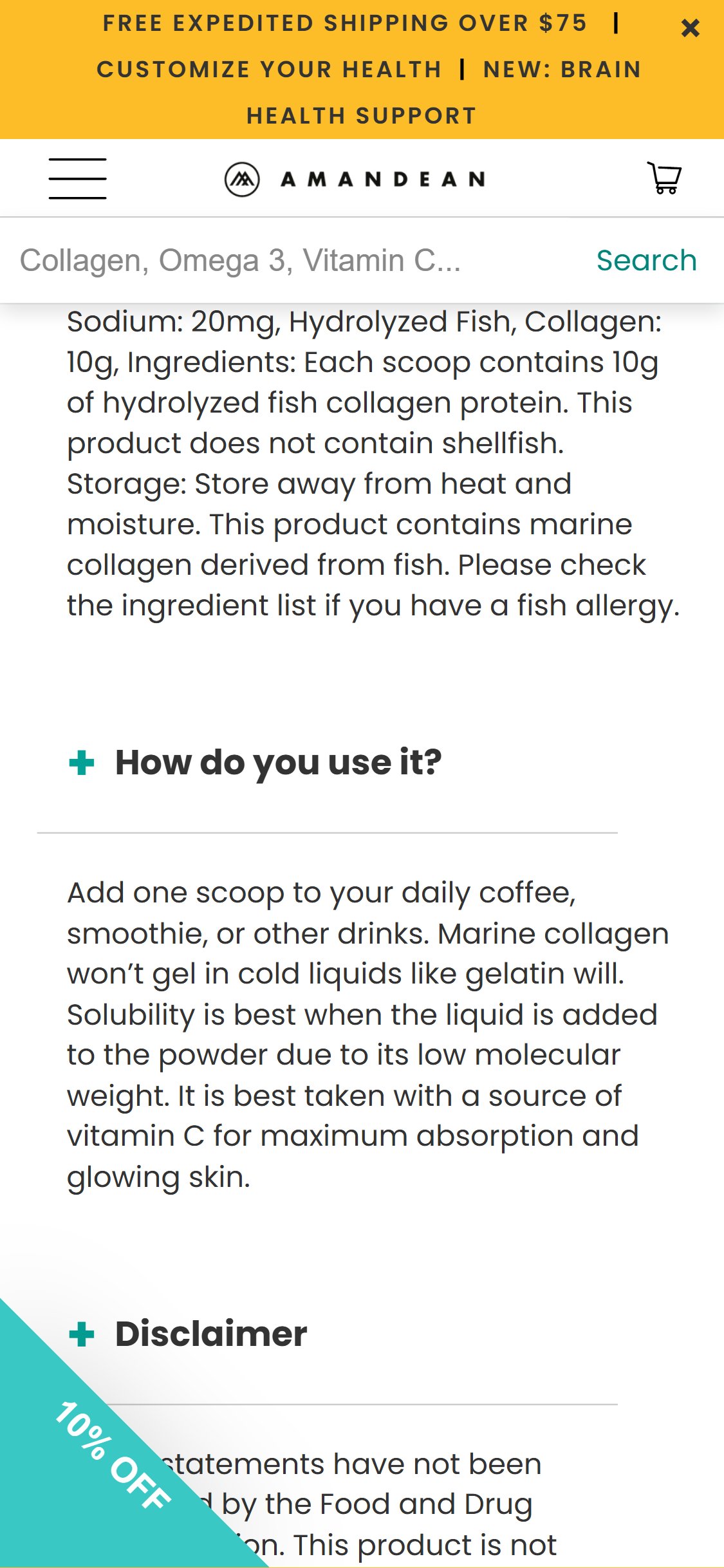
- The 'Ingredients' accordion reveals serving size and nutrient data as a single comma-separated prose paragraph: 'Serving Size: 10 grams, Servings per Container: 50, Calories: 45g, Protein: 9g, Sodium: 20mg, Hydrolyzed Fish Collagen: 10g' — no table, no grid
- There is no % Daily Value column, no visual separation between nutrients, and no official supplement facts formatting — failing the FDA-standard layout that health-conscious US shoppers expect
- 90% of US H&W stores provide structured supplement facts panels (Ritual, Seed, Onnit, Moon Juice all use table or grid formats)
- All accordions on the PDP are collapsed by default — even the unstructured text is hidden until the user actively taps 'Ingredients'
Recommendations
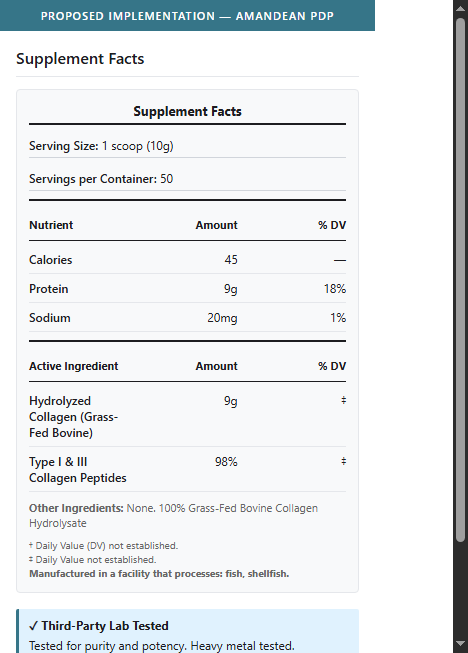
- Replace the plain-text ingredients accordion with an HTML supplement facts table: columns for Ingredient Name, Amount per Serving, % DV — styled to match the FDA supplement facts panel format
- Pre-expand the 'Ingredients' accordion by default (or make it the first open section) so supplement facts are visible without a tap
- Add a separate 'Supplement Facts' image upload (actual label photo) alongside the HTML table for regulatory completeness and visual credibility
All PDP Accordions Collapsed by Default — Key Product Info Hidden Behind Taps
Observations
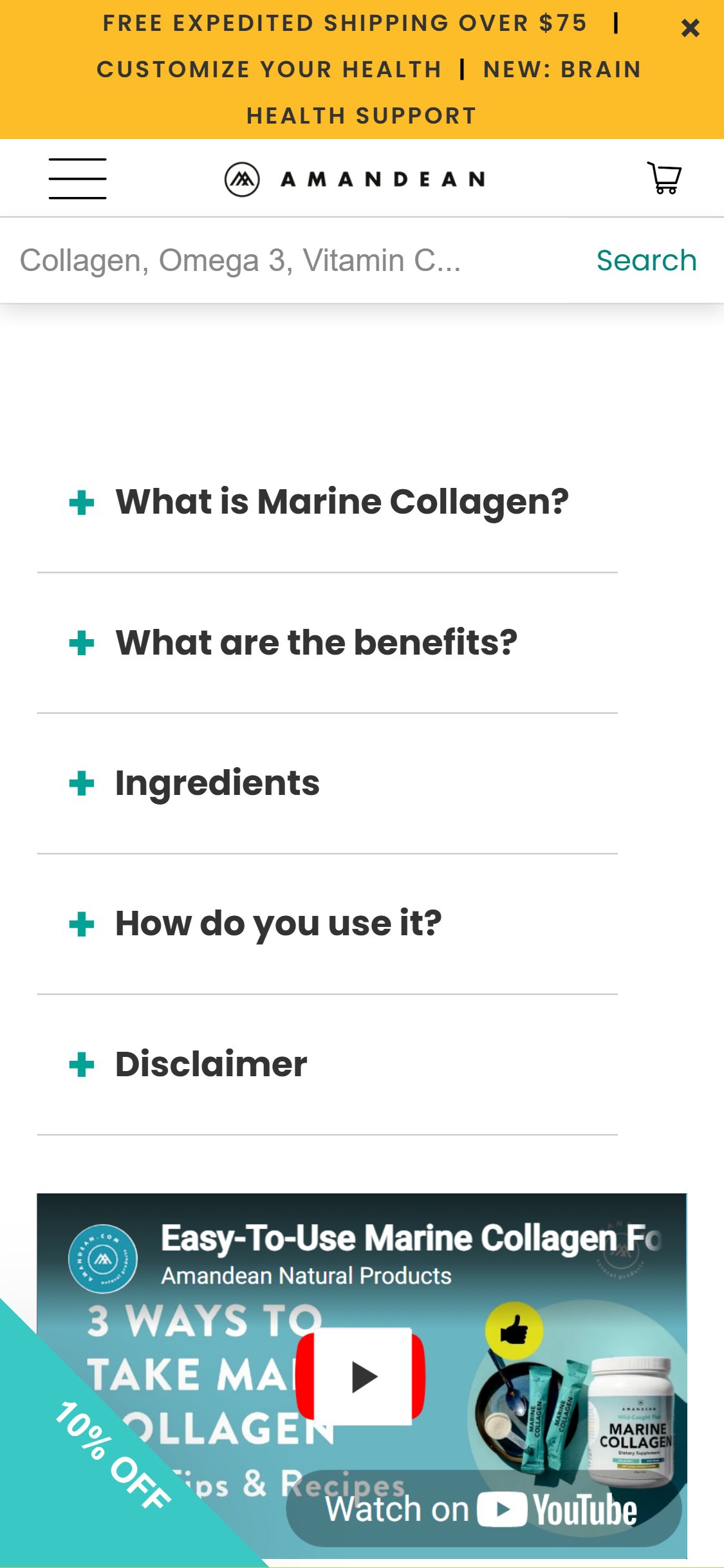
- All 5 accordion sections ('What is Marine Collagen?', 'What are the benefits?', 'Ingredients', 'How do you use it?', 'Disclaimer') are collapsed with '+' icons — no content is visible below the benefits icons without user interaction
- The pass criterion requires at least one section expanded by default to guide users to the most important information first
- Moon Juice, The Nue Co., and Onnit all pre-expand 'Benefits' or 'How To Use' by default, making the page scannable
- Users on mobile who don't tap accordions leave without seeing dosage instructions, ingredients, or benefit details — key purchase drivers
Recommendations
- Pre-expand 'What are the benefits?' as the default-open section — this is the highest-intent content for a first-time visitor
- Keep 'Ingredients' and 'How do you use it?' collapsed but visually indicate they're expandable — users who need deeper validation can self-select
- Consider a progressive disclosure pattern: show first 2 lines of each section with 'Read more' — prevents the 'all collapsed' problem without overwhelming the page
No HSA/FSA Eligible Badge — Missing a Key US Purchase Motivator
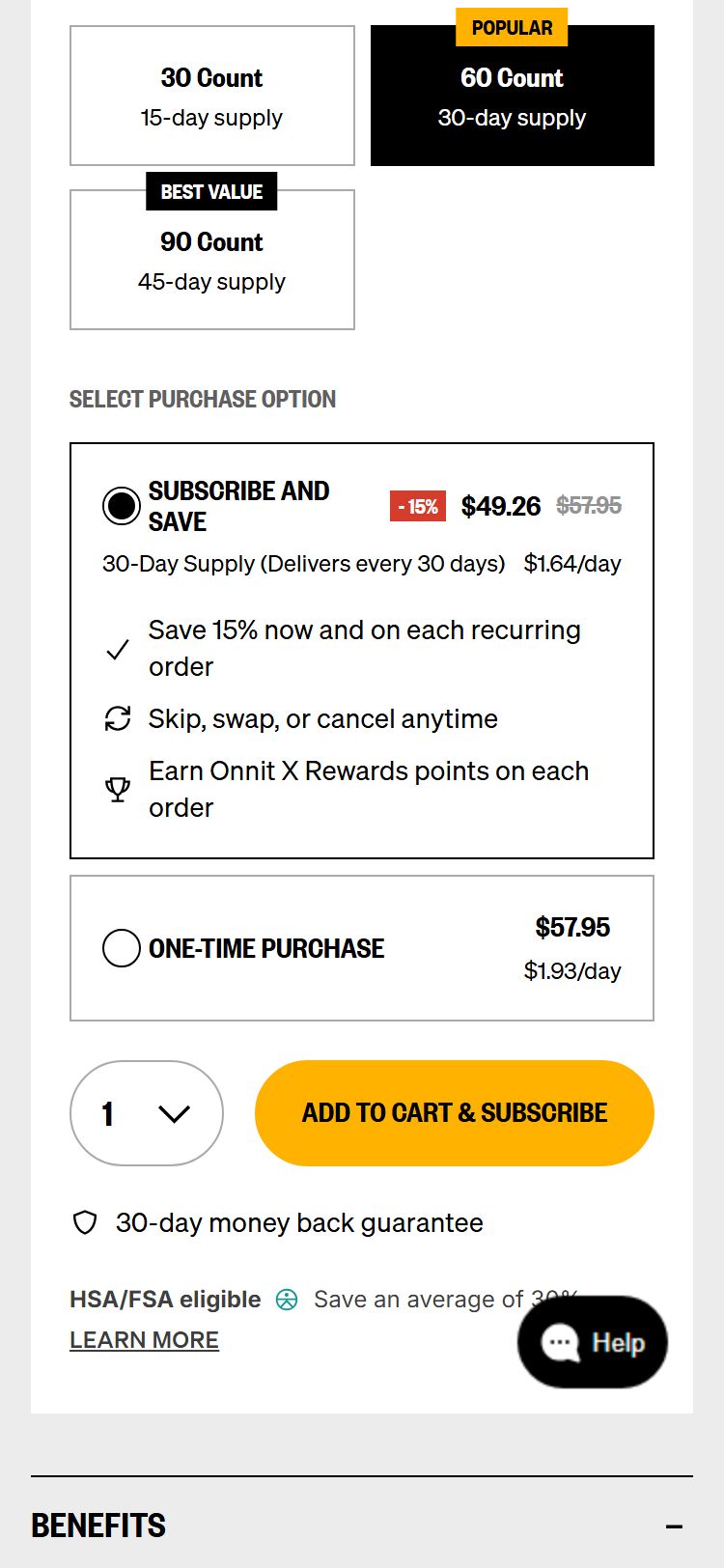
Observations
- No HSA/FSA eligible badge appears anywhere on the PDP — not near the price, not in the ATC zone, not in the accordion sections
- If Amandean's supplements qualify for HSA/FSA (which hydrolyzed collagen and omega-3s may based on use case), this is a missed conversion lever — 20% of US H&W stores display this badge
- Ritual and Onnit both display 'HSA/FSA Eligible — Save an average of 30%' near the price, directly reducing the effective price barrier for US buyers
- US consumers with HSA/FSA accounts actively seek out eligible supplements and use eligibility as a tiebreaker between comparable products
Recommendations
- Verify eligibility of each SKU with an HSA/FSA eligibility verification service (e.g., Truemed, FSA Store partnership) — if eligible, add the badge immediately
- Display 'HSA/FSA Eligible' as a badge pill near the subscription/one-time selector — position it where it reinforces the price perception alongside the subscription savings
- Add 'Pay with HSA/FSA' as an informational callout in the ATC zone with a small tooltip explaining how to use HSA/FSA cards at checkout
No Urgency Triggers in Cart — Items Sit With No Time Pressure to Complete Purchase
Observations
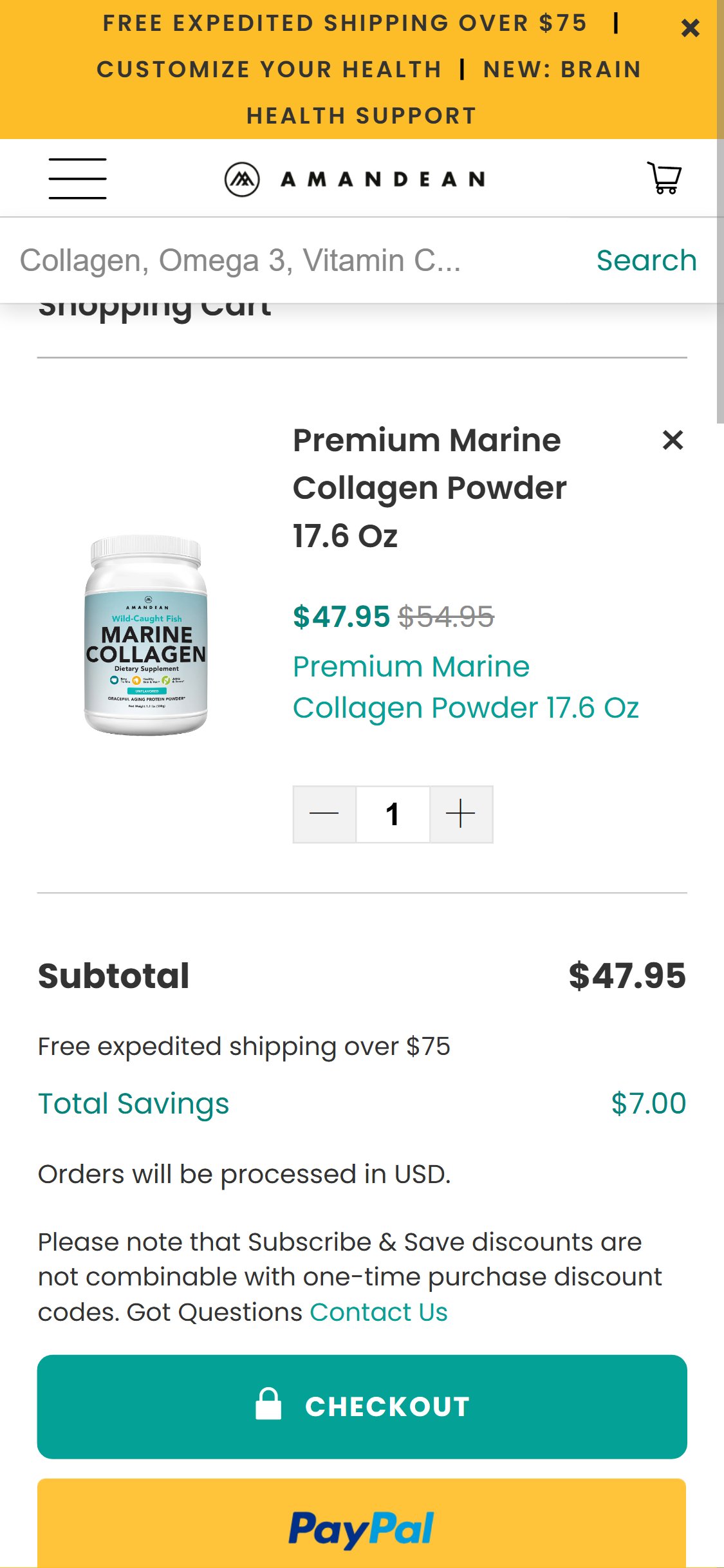
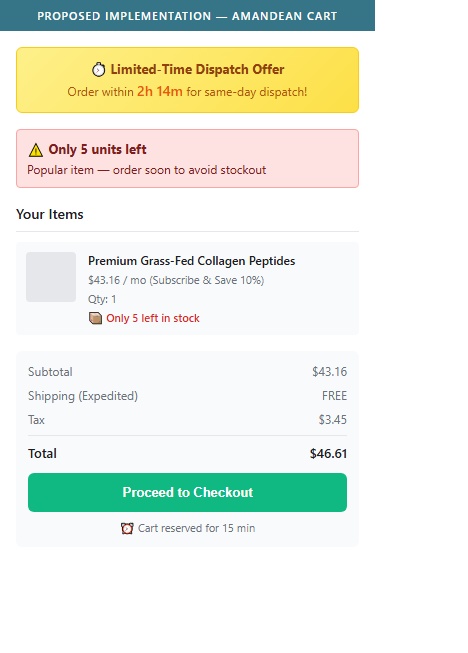
- The cart page and cart drawer show item, quantity, subtotal, and checkout button — zero urgency elements: no 'reserved for X minutes' timer, no 'X left in stock' indicator, no same-day dispatch countdown
- Items remain in cart indefinitely with no time pressure — health supplements have high cart abandonment (industry avg 70–75%) and urgency elements directly address indecision
- Onnit, Moon Juice, and The Nue Co. all use stock scarcity ('Only 3 left') or dispatch urgency ('Order within 2h 14m for same-day ship') as standard cart elements
- The cart page shows $7.00 savings and a clean checkout — the infrastructure for messaging is there, urgency copy is missing
Recommendations
- Add a per-line-item stock counter for products with limited inventory: 'Only 8 left in stock — order soon'
- Add a same-day dispatch countdown in the cart summary: 'Order within 3h 22m for same-day fulfillment' — resets daily at cutoff time
- Alternatively, add a simple 'Cart reserved for 15 minutes' progress bar timer near the checkout button to create gentle time pressure
Free Shipping Threshold Has No Progress Bar — Cart Misses Upsell Nudge
Observations
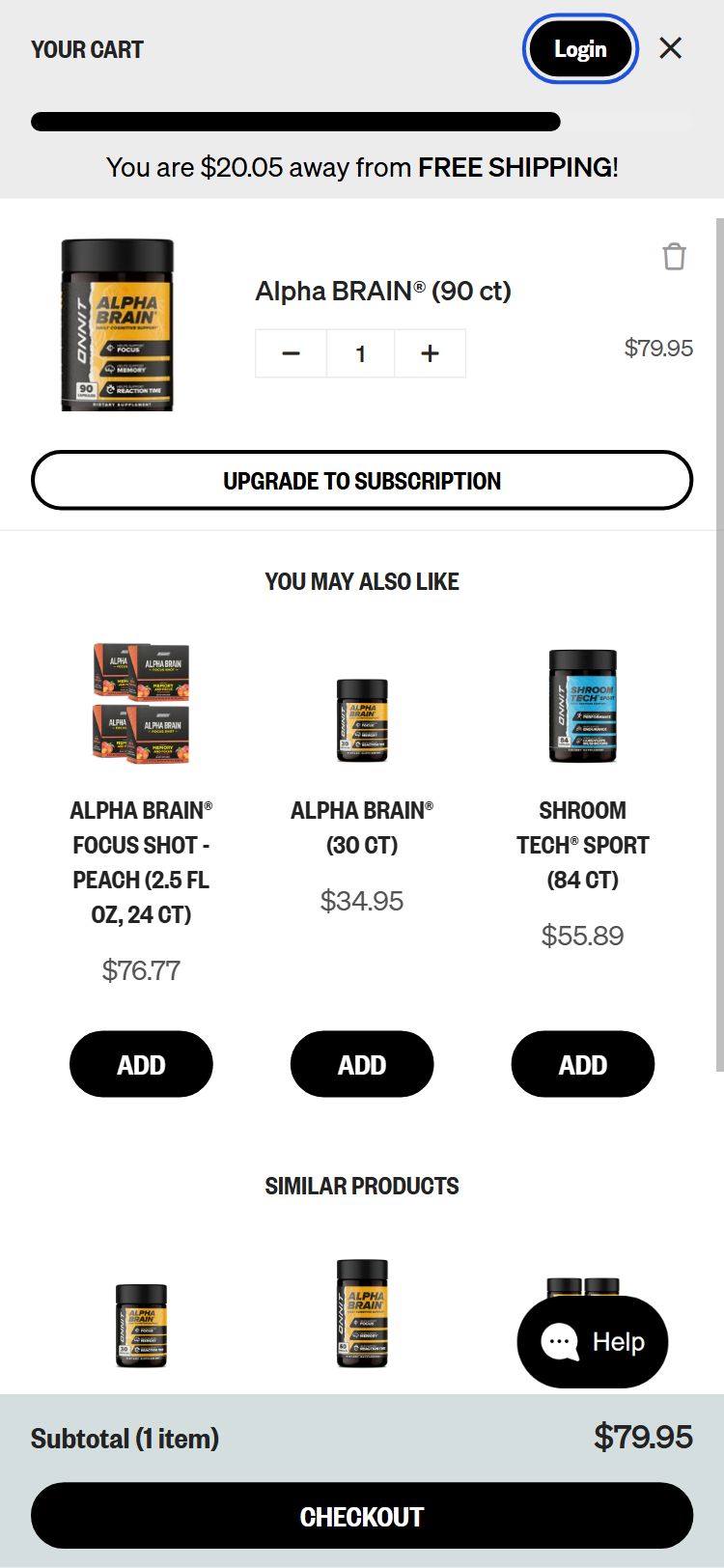
- Cart shows 'Free expedited shipping over $75' as a static text line — no visual progress bar showing how close the order is to the threshold
- A customer with $47.95 in cart is $27.05 away from free shipping — a well-placed progress bar ('Add $27.05 more to unlock free expedited shipping') reliably increases AOV by 15–25%
- 60% of US H&W stores use progress bars with product suggestions to bridge the shipping gap (Moon Juice, Onnit use this pattern in cart drawer)
- Amandean's announcement bar already communicates the $75 threshold — the cart should reinforce it with a visual and a cross-sell nudge
Recommendations
- Add a visual progress bar at the top of the cart: '[==== ] $27.05 more for FREE expedited shipping' — updates dynamically as cart value changes
- Pair the progress bar with a 1–2 product suggestion strip: 'Popular add-ons to unlock free shipping' showing $20–$30 items (Magnesium, Vitamin C)
- Use Rebuy (already installed) to power the 'add to unlock free shipping' cross-sell widget — no new app needed
04
App Ecosystem
What's installed vs what's missing from best-in-class Health & Wellness stores
Present (11)
Recharge Payments
Subscriptions & Recurring
Legacy widget mode — consider migrating to Recharge Checkout or Shopify Subscriptions native for better analytics and customization
Rebuy Smart Cart
Upsell & Cross-sell
Powers cart drawer, 'You may also like' cross-sell in cart, and 'Frequently Bought Together' on PDP. Well configured. Consider enabling the free-shipping progress bar feature.
Klaviyo
Email & SMS Marketing
Email popup with 10% off incentive confirmed active. SMS capture form present. Both email and SMS flows appear configured — strong retention infrastructure.
Okendo Reviews
Reviews & Social Proof
Reviews are present and active with photo UGC on PDP. 4,590 total reviews is strong social proof. Photo reviews visible in the reviews gallery.
Hotjar
Analytics & Heatmaps
Session recording and heatmap tool. Running alongside Microsoft Clarity — dual heatmap tools is redundant.
Microsoft Clarity
Analytics & Heatmaps
Free heatmap/session recording. Running alongside Hotjar — one of these is redundant. Clarity is free and comparable quality; consider removing paid Hotjar.
Google Analytics 4 + GTM
Analytics
Standard GA4 + GTM setup. Two Facebook Pixels detected — worth auditing for duplicate event firing in Facebook Events Manager.
Facebook Pixel
Paid Attribution
Two Facebook Pixels firing on the same page is unusual — may indicate a legacy pixel (from an old ad account) still firing alongside the current one. Duplicate events inflate reported conversions and distort ROAS. Audit in Facebook Events Manager and remove the legacy pixel.
Bing Ads Pixel
Paid Attribution
Standard Microsoft Advertising pixel.
Reddit Pixel
Paid Attribution
Reddit ads attribution. Appropriate for Amandean's demographic (health-conscious 25–45 demographic active on Reddit).
Pinterest Tag
Paid Attribution
Pinterest attribution pixel. Appropriate for health & wellness supplements with strong visual appeal.
Missing (6)
Loyalty & Rewards App (Smile.io / LoyaltyLion) Critical
Loyalty & Retention
🔄 Repeat purchase rate +20-35%
65% of US H&W DTC brands use loyalty programs
Product Filter & Search App (Boost Commerce / Searchanise) Critical
Search & Discovery
📈 Collection CVR +18-25% with filters
80% of DTC stores with 10+ SKUs use filter apps
BNPL / Pay Later (Afterpay / Klarna) Critical
Payments & Checkout
📈 AOV +25-40% with BNPL option
55% of US H&W stores offer BNPL for $40-$60 products
Referral Program App (ReferralCandy / Friendbuy) Critical
Customer Acquisition
💰 CAC reduction 20-30% via word-of-mouth
45% of H&W subscription brands run referral programs
Live Chat / Helpdesk (Gorgias / Tidio) Critical
Customer Support
📈 Cart abandonment recovery +8-12%
60% of Tier 2 DTC brands use live chat on PDP and cart
Sticky Add-to-Cart App (Sticky ATC / Hextom) Critical
Conversion Optimization
📈 Mobile ATC rate +12-20%
90% of top-performing Shopify health stores use sticky ATC on mobile
App Stack Assessment
11 apps detected, 6 critical gaps identified
Confidential — Prepared for Amandean by Growisto | June 2026